Is “eat less and run more” really the only thing you need to know in order to lose weight?
Why is it then that most people lose weight on a LCHF diet, even when eating until satisfied? And this without even any increase in exercise? To think that this should be so controversial!
The best explanation, in a simplified version, looks like this:
Carbohydrates – > insulin – > obesity
Thus more carbohydrates lead to more insulin which leads to more fat accumulation. With more details this can be written as follows:
Too many (bad) carbohydrates – > pathologically high insulin levels – > obesity
What constitutes “too many” varies from person to person depending on sensitivity and activity level (how much carbs you burn). Intensely exercising young men can often tolerate a fair amount of carbs, while heavily overweight older diabetics can only tolerate minimal amounts without problems.
The opposite is the following:
Less carbs – > lower insulin levels – > loss of excess fat
Insulin is a fat storing hormone. And the easiest way to increase your insulin levels is to eat more carbohydrates. The easiest way to lower insulin levels is to eat fewer carbohydrates.
This seems very straight forward. But some are still adamant opponents. Without being able to come up with any better explanation as to why a low-carbohydrate diet works (it does) they still don’t want to accept this explanation. They come up with all kinds of objections. Some don’t even want to recognize the most basic, that carbohydrates increase insulin levels or that a low-carb diet lowers insulin levels.
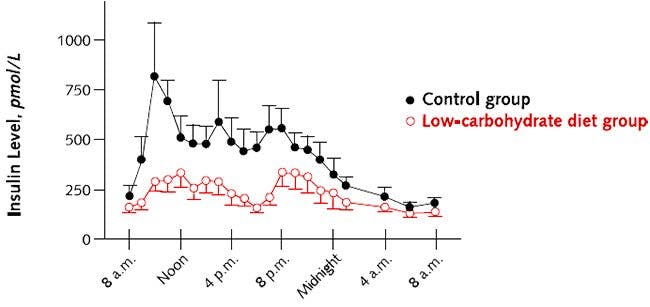
Their complicated objections don’t matter much in reality. The truth is clear in study after study on humans. Insulin levels are much higher when you eat a lot of carbohydrates and lower on a low-carb diet. The figure above (from Boden et al.) is one example.
Here are some more:
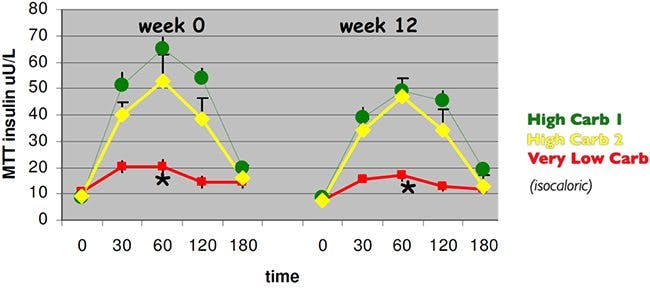
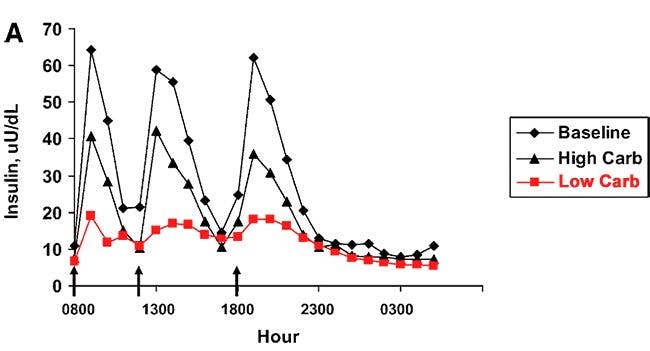
Much Lower Insulin Levels on a Low-Carbohydrate Diet

Figure from Noakes et al.

Figure from Hernandez et al.
Lower Insulin, Lower Insulin, Much Lower Insulin
Does a low-carbohydrate diet lower insulin? There is only one answer: Yes, insulin levels decrease greatly throughout the entire day.
One could only wish that the insulin deniers could at least accept something this basic.
Previously
The #1 Cause of Obesity: Insulin
P.S.
Even fasting insulin levels have been shown to be lower on a low-carb diet (for example: Samaha et al., Volek et al.)


90


I just read this abstract:
"In healthy Swedish 4-y-olds from well-educated families, low fat intake was related to high body mass index. Upward weight and height percentile crossings were related to insulin resistance, especially in girls."
http://www.ncbi.nlm.nih.gov/pubmed/17093153
- VLCarbs ate 4g carbs
- VLFat ate 89g carbs (High carb 1) or 60g (High carb 2)
So 4g carbs don't spike insuline... nice finding
BTW, the study is very interesting, and raises lots of questions. If ou want to read it in full :
http://www.ncbi.nlm.nih.gov/pmc/articles/PMC1368980/
LCHF reduce insuline, but for a large part because there is a lot less glucose to handle.
In dairy, proteins are "very" insulinogenic and fat tend to amplify the insuline response. But butter in isolation would have nearly no effect on insuline, and cream just a bit more (still low in protein). On Peter's blog, you can see the effect of cream vs. casein.
To be fair, carbs are (generally) more insulinogenic than proteins.
But to be fair also, insulin is a lot more than an evil fat pusher... it's a highly useful anabolic hormone. A vital one. And it's not evil.
as this will lead to multiple vitamin and mineral deficiencies,
neurological damage, immune system malfunction,
mental health problems,......................................and so on.....
It is especially nasty if this is being pushed on pregnant/young women and children.
Being low-fat does NOT make a high-carb diet any safer. (Even though this is often being stated, I doubt that this is true overall.)
Again: http://www.ncbi.nlm.nih.gov/pubmed/17093153
http://healthimpactnews.com/2012/the-clue-to-why-low-fat-diet-and-sta...
.....and so much more
http://www.drbriffa.com/2013/02/28/evidence-points-to-dairy-products-...
You may also be interested in this regarding dairy. (Not so evil after all!) Store-bought dairy is mostly highly processed and adulterated food, of course, and does not resemble the real thing. I eat high fat diary liberally, with great success.
Processed sugars and grains, high omega-6 oils like soybean and corn all responsible for epidemic disease
Learn more: http://www.naturalnews.com/035295_low-fat_diet_heart_disease_medical_...
It is very important to cut out the (unhealthy) carbs AND increase the (healthy) natural fats.
And then there is this one: http://www.hindawi.com/journals/bmri/2013/921348/abs/
Fat people lack vitamin D, because they are fat (not only the other way around).
(cannot find the other study right now, where it states that high-carb reduces Vitamin D receptors on the cells)
Cutting the carbs will fix this, cutting fatty foods (natural fats) will make this worse.
- Years of high insulin causes arteries to constrict and grow their muscle layer (-> hypertension)
- Insulin acts as a functional aldosterone agonist on the kidneys, thus retaining volume (-> hypertension)
- Insulin inhibits active uric acid excretion in the kidney (-> gout)
...
And the list goes on. You just have to search for it.
A Type 2 Diabetic may be characterised as having too much insulin -- at least in the years leading up to diagnosis... by the time of diagnosis we may have lost upwards from 50-80% of our insulin secreting capacity... which means: the few remaining beta cells are working flat out to maintain the "balance" between high Blood Glucose levels and life -- if that stress continues they will likely also burn out.
In both cases high levels of insulin (endogenous OR exogenous) may be harmful -- as laid out by dr-no)
Restricting dietary carbohydrates is an effective way to reduce the amount of insulin that we need to secrete or inject.
Traditionally (and this is a generalisation) a Type 1 would limit the number of injections per day and err on the side of safety by running with a slightly higher than normal Blood Glucose (BG). Too much insulin, without Glucose to balance it, can lead to a dangerously low BG levels.
These folks would invariably be lean, verging on skinny and many needed to lead a very structured day.
Nowadays with the advent of continuous insulin infusion devices or "insulin pumps" a Type 1 may infuse as much insulin as they desire, to balance what they eat.
Increasingly there are Type 1s who look more like the "normal" population: overweight, obese, metabolically disordered and in more and more cases going on to develop Type 2 or "double diabetes" as well.
Ask any Diabetic -- "It's the Insulin Stupid!"
carbs -> insulin -> obesity
. . . . . . . . I
. . . . . . . . I-> excess hunger -> more carbs -> more insulin -> more obesity
. . . . . . . . I
I-> more hunger -> etc.
Not only is insulin a fat storage hoirmone, it also increases hunger when it is not actively dealing with glucose because of low blood sugar. It becomes a vicious obseity cycle.
Maybe, i'll try again.
I like the simple graphic carbs -> insulin -> obesity. However, as a Type 1 diabetic, i don't think it explains all of the damaging effects of high insulin levels. Maybe the following would be better:
carbs -> insulin -> obesity
. . . . . . . . I
. . . . . . . . I-> excess hunger -> more carbs -> more insulin -> more obesity
. . . . . . . . . . . . . . . . . . . . . . . . . . . . . . . . . . . . . . . . I
. . . . . . . . . . . . . . . . . . . . . . . . . . . . . . . . . . . . . . . . I -> more hunger -> etc
Too many (bad) carbohydrates – > pathologically high insulin levels – > obesity
For the benefit of LCHF neophytes and potential adherents, I'd like the Dr. or somebody as knowledgeable, to describe what is "Too many carbohydrates" and what are "(bad) carbohydrates" in order to design an effective LCHF way of eating.
I also wish that more emphasis was placed on LCHF reduction of FBG, considered by many the main indicator of potential cardiac problems.
As Doctor Andreas already stated in this blog post "What constitutes “too many” varies from person to person depending on sensitivity and activity level (how much carbs you burn). Intensely exercising young men can often tolerate a fair amount of carbs, while heavily overweight older diabetics can only tolerate minimal amounts without problems."
For me "bad carbs" are the simple sugars and refined starches as found in processed and packaged food e.g. soda, breakfast cereal, pasta, bread, cakes etc... These do not exist in real whole food (usually does not require a label) with the exception of honey, sweet fruits and possibly starchy root vegetables.
Some may be able to eat real whole food including fruit and starchy root vegetables, while others (like myself) cannot tolerate many, if any, of these without adversely affecting my Blood Glucose (BG).
You may find it useful to invest in a BG meter (the test strips are what tend to cost the most) and do some self-experimenting to find out which foods you can tolerate and which you can't... basically if you don't have Diabetes and a food tends to raise your BG, you can assume it is also raising your insulin. If you eat it often, then your insulin will be raised more of the time.
Eating real whole food, locally sourced and prepared at home is (for me) the simplest approach to an LCHF diet... not need for any fancy formulas... just as nature intended for humans and every other animal.
People can live on high carbs too, but they usaly eat them as whole food.. like tubers, vegetabels and fruit!
Or as Gary Taubes says.. if we didnt eat those refined carbs we can probably eat the rest!
BG is constantly changing (hopefully staying within the normal range) but to focus on just FBG is like doing the weather forecast based on a series of measurements taken only at 8am each day for a month, while ignoring what happens over the remainder of each day.
For myself (with Type 2 D) my FBG is usually the worst of my day (but only just above normal)... eating LCHF has given me very stable and predictable BGs through the rest of the day with only my FBG raised, by what is called Dawn Phenomenon.
FBG may serve as risk predictor of CVD but only insomuch as Type 2 Diabetes is a risk factor for CVD and a raised FBG is often one of the first symptoms detected by Doctors when someone is diagnosed with Type 2. BUT this misses the fact that the Type 2 has probably been developing for many years prior to that fateful day of diagnosis... and just as it tends to progress downwards after diagnosis (especially if one follows the standard advice) its progression could also have been slowed, stopped, or even reversed by even earlier detection.. for example by administering an OGTT which challenges the system to handle a mass influx of Glucose.
Unfortunately the ADA and other august bodies prefer to consciously err on the side of under-diagnosis in order to spare people a potentially awkward and costly diagnosis... for example it can adversely affect your insurability.
In my opinion this is short-sighted; as surely it is far easier to lower the water pressure and shore up a dam BEFORE it has burst through?
@ Zepp: Concise and to the point
Both: Thanks!
as this will lead to multiple vitamin and mineral deficiencies,
neurological damage, immune system malfunction mental health problems,......................................and so on."
Gosh, Sabine, that explains why 82% of Dean Ornish's patients were hospitalized during his studies. I suppose Medicare will stop paying for his treatment plan when they find out what you know.
. Ya think...?.
Dr Ornish is not that dumb that he put people on a diet short of nutrients!
Keep in mind that dietary protein is also insulinogenic, and that the body can store fat in the absence of insulin (via acylation stimulating protein) - two facts that these neo-Atkins types COMPLETELY ignore, either due to genuine ignorance, or to sell books.
One dont fell any good with cronicaly eleveted insulin levels.. one get hungry and tired!
One is forced to deliver surplus energy!
ASP do only react on Chylomicrons.. how only is delivering a small part of your meals.. ie, only longer fatty acids.
And insulin is still the major regulator of esterification and reesterification of triglycerids.
How does one get the FFA out to make ATP in cells if Insulin inhibit the lipolysis?
If one is att nomal weight.. one dont get excesses of calories.. and I think its the excesses that bad.. not the normal amounts of food.
I never seen that a to low consumption of energy and nutrients have any benefits?
I think its a misconception.. that starving should be a better alternative to binge eating!
Ask any of your medical teachers what hapens if you inject insulin (satiety hormone??) without eating any carbs!
http://en.wikipedia.org/wiki/Insulin_shock_therapy